Great expectations as an illusion of wealth and status
Great ExpectationsGreat expectations as an illusion of wealth and status is the belief that money, gentility, and social ascent will deliver fulfillment. Pip’s story exposes that belief as a costly misreading: his hopes shape how he sees his home and the people who care for him, while their eventual collapse leaves him to rebuild his life through honest work, repayment, and renewed friendship.
The Making of an Expectation
Pip’s early sensitivity to injustice and humiliation helps prepare the ground for his social ambition. Recalling his upbringing by his sister, he describes how a child can feel injustice keenly even when the injury seems small to an adult. That history helps explain his susceptibility to Estella’s contempt: a painful encounter becomes more than an isolated slight, and contributes to his conviction that he must become uncommon.
After visiting Miss Havisham, Pip begins to imagine that social advancement will transform his future and his relationships. He projects a romantic plot onto Satis House: he pictures himself restoring its darkened rooms and marrying Estella, treating his own hopes as though they were Miss Havisham’s intentions. The older narrator corrects that fantasy. He says he loved Estella because he found her irresistible, even while knowing that the attachment worked against reason, hope, and happiness. The admission distinguishes the reality of his feeling from the story he constructed around his prospects.
Status and Estrangement
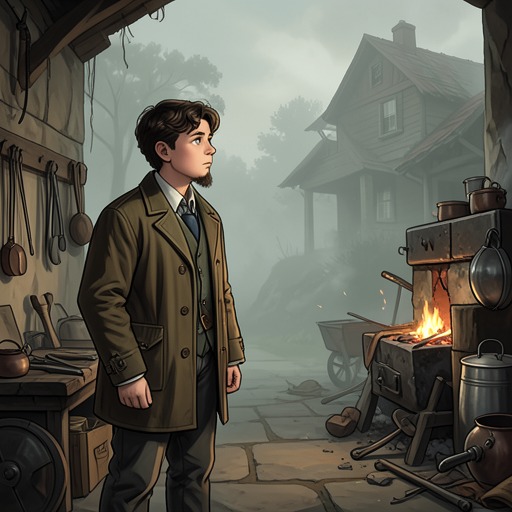
The prospect of becoming a gentleman changes the meaning Pip assigns to home. He remembers that Joe had made the household seem welcoming and the forge a path to independence; after his visits to Satis House, he sees those same surroundings as coarse and common, and is ashamed to have Miss Havisham and Estella see them. He recognizes that the change in him cannot simply be assigned to one cause: Miss Havisham, his sister, and his own choices all figure in the retrospective account, but the consequential fact is that his view of home has altered.
When Pip’s expectations are announced, Joe and Biddy respond with warmth, yet their cheerfulness makes Pip gloomy. He feels offended by their kind looks and imagines that their ordinary surroundings reflect poorly on him. His reaction exposes the inward cost of aspiration: even before he leaves, he is beginning to interpret affection as a reminder of the identity he wants to outgrow. His later account acknowledges that he may have been dissatisfied not with his fortune but with himself.
The sharpest reversal arrives when Pip learns that Miss Havisham did not intend him for Estella and that his rise was not part of the romantic design he had imagined. He also recognizes that he has deserted Joe for a benefactor whose crimes he does not know. At the close of the second stage of his expectations, Pip’s imagined future has given way to shame and fear; the status he pursued has not secured love, belonging, or moral confidence.
Collapse and Material Consequences
Pip’s loss of wealth is not merely a change in his prospects. When he returns to his native place, news of his diminished fortunes has already reached the Blue Boar, whose formerly assiduous manner toward him has cooled. The inn cannot give him his usual room and assigns him an inferior one. The changed welcome makes social regard appear conditional on property, while Pip’s acceptance of the room without distress marks a shift in what he values.
Satis House, too, is being dismantled. On Pip’s return, auction notices announce the sale of its furniture and effects, and the house is to be sold as old building materials and pulled down. The ivy has been stripped away to make space for lot numbers. The physical dispersal of the house that fed Pip’s romantic imagining parallels the collapse of his expectation: neither its ruins nor his former hopes can be made into the future he once pictured.
After illness and recovery, Pip learns that Joe has paid the debt and costs that led to his arrest. The receipt is in Joe’s name. Pip’s response is to resolve to return to the forge, disclose what he has withheld, and make a penitent appeal. He also imagines asking Biddy to accept him despite his faults and disappointments. The reversal is ethical as well as financial: when Pip can no longer rely on imagined patronage, he begins to recognize the practical care he had received from those he had looked down on.
Work, Friendship, and a Different Measure of Success
Pip sells what he has and sets aside as much as he can to reach an agreement with his creditors; they give him ample time to repay them in full. He leaves England to join Herbert, becomes a clerk at Clarriker and Co., and within four months assumes sole responsibility for the Eastern Branch while Herbert is away. His future is no longer a romantic reward bestowed by a mysterious patron, but a working life built through responsibility and industry.
Pip and Herbert eventually become partners, though the firm never grows into a great or exceptionally wealthy house. Pip describes a modestly successful business with a good name, sustained by work and Herbert’s cheerful industry. He remains on good terms with Herbert and his wife, pays his debts, and corresponds constantly with Joe and Biddy. In retrospect, he questions his earlier judgment that Herbert was inept, realizing that the deficiency may have been in his own perception.
The novel’s closing image of rising mists recalls Pip’s earlier departure from the forge, but the return is not a restoration of his former ambitions. He leaves the ruined place with Estella and sees no shadow of another parting. The ending offers renewed friendship rather than a confirmed union, and its quiet openness contrasts with the certainty of the future Pip once invented for himself. Great expectations lose their force as a promise of rank; the more lasting outcome is a life shaped by work, repayment, affection, and a less contemptuous understanding of home.